1. Arrays and Strings
Arrays and Strings
*Most of the time Strings are created as arrays, so useful to lump them together. Creating new strings from scratch is typically an O(n) operation, so you use lists to store things and create one at the end
Time Complexities
This is for storing arrays as contiguous set of items in memory, and not as a Linked List
| Operation | Array | String |
|---|---|---|
| Append to End | * | |
| Pop From End | ||
| Insert in Middle | ||
| Delete in Middle | ||
| Modify Element | ||
| Random Access | ||
| Check if Element Exists |
- The insert / delete in the middle is O(n) because you typically have to shift all elements in the array to a new storage location either +1 or -1, which means you would loop over all the elements and shift
- Insert or pop from end means you just remove that last storage location, and wouldn't be affected by size of the array
Common Algorithms
TLDR;
- Stacks are very useful for reversing strings!
- Subarrays where you have to find something of a certain size, or a certain sum, etc > some target, use sliding windows
- "If a problem has explicit constraints like
sum greater than or less than k, orlimits on what is contained, such as max of k unique elements, and it also asks formin/max length,# of subarrays, ormax or min sum, consider sliding windows" - The size of a subarray between
iandj(inclusive) isj - i + 1. This is also the number of subarrays that end atj, starting fromior later - Sliding windows can use
left, right, or they can just dofor right in range(k, len(s))
- "If a problem has explicit constraints like
- Prefix sum gives sum of subarrays
- If we want the sum of the subarray from
itoj(inclusive), then the answer isprefix[j] - prefix[i - 1]
- If we want the sum of the subarray from
Two Pointers
- Typically useful when you have two pointers, left and right, and you either increment or decrement them based on some criteria
- Allows us to do things like Palindrome or Two Sum (sorted array) in time and space
- Left and Right can be:
- front and back
- front and front
- Arr1 and Arr2
- Meaning left points at Arr1 front or back, and right points at Arr2 front or back
- The commonality is that you can perform calculations in time and space
function fn(arr):
    left = 0
    right = arr.length - 1

    while left < right:
        Do some logic here depending on the problem
        Do some more logic here to decide on one of the following:
            1. left++
            2. right--
            3. Both left++ and right--
def check_if_palindrome(s):
    left = 0
    right = len(s) - 1

    while left < right:
        if s[left] != s[right]:
            return False
        left += 1
        right -= 1

    return True
- Two Pointers doesn't need to be implemented in front and back, left and right can both start at the front
- Merge Sort in where both arrays are sorted
- Or problems like subsequences and subarrays, we'd move left along big array until it matches the start of subsequence array, and then move right as those indeces match
function fn(arr1, arr2):
    i = j = 0
    while i < arr1.length AND j < arr2.length:
        Do some logic here depending on the problem
        Do some more logic here to decide on one of the following:
            1. i++
            2. j++
            3. Both i++ and j++

    // Step 4: make sure both iterables are exhausted
    // Note that only one of these loops would run
    while i < arr1.length:
        Do some logic here depending on the problem
        i++

    while j < arr2.length:
        Do some logic here depending on the problem
        j++
def mergeSortedArrays(arr1, arr2):
    # ans is the answer
    ans = []
    i = j = 0
    while i < len(arr1) and j < len(arr2):
        if arr1[i] < arr2[j]:
            ans.append(arr1[i])
            i += 1
        else:
            ans.append(arr2[j])
            j += 1

    while i < len(arr1):
        ans.append(arr1[i])
        i += 1

    while j < len(arr2):
        ans.append(arr2[j])
        j += 1

    return ans
def isSubsequence(self, s: str, t: str) -> bool:
    i = j = 0
    while i < len(s) and j < len(t):
        if s[i] == t[j]:
            i += 1
        j += 1

    return i == len(s)
Sliding Window / Subarray
- A Subarray is a contiguous section of the array
- Subarray problems are usually solved with a variation of Two Pointers, where the left is front and right = left, and then you move along the axis checking if the definition for the subarray is true or not
- If you simply checked each subarray using brute force double loop we'd have
- n arrays of size 1
- n - 1 arrays of size 2
- n - 2 arrays of size 3
- ...
- 2 arrays of size n - 1
- 1 array of size n
- Therefore, we'd have total arrays, which is
- A sliding window approach keeps things to at most
- The reason this is and not is because of amortized analysis which means that the nested while loop and the outer while loop can run at most N times altogether, if the inside loop runs N times on the first outer loop, then it would run 1 times for every further loop, and would never run N times for N iterations
- Everything averages out to when you consider all runtimes
- Typical problems include the following constraints, that are typically checked in the function
checkArr(left, right)- Length of largest subarray
- Length of largest subarray k
- Longest subarray with at least 1 character X
- ...
- Number of valid subarrays
- First valid subarray
- Last valid subarray
- The below function uses
curr += nums[right]andcurr -= nums[left]which is random access so it's - That being said, there are some sliding window problems that need more advanced data structures in the middle for checks
- Sliding Window Maximum problem is a good example, where you need an entire monotonic deque in the middle with while loops and
checks()to update during the window, but ultimately the sliding window is the same
- Sliding Window Maximum problem is a good example, where you need an entire monotonic deque in the middle with while loops and
- Length of largest subarray
Show Python Script
function fn(nums, k):
    left = 0
    curr = 0
    answer = 0
    for right in range(len(nums)):
        curr += nums[right]
        while (curr > k):
            curr -= nums[left]
            left++

        answer = max(answer, right - left + 1)

    return answer
function fn(arr):
    left = 0
    for right in range(len(arr)):
        Do some logic to "add" element at arr[right] to window

        while WINDOW_IS_INVALID:
            Do some logic to "remove" element at arr[left] from window
            left++

        Do some logic to update the answer
def find_length(s):
    # curr is the current number of zeros in the window
    left = curr = ans = 0
    for right in range(len(s)):
        if s[right] == "0":
            curr += 1
        while curr > 1:
            if s[left] == "0":
                curr -= 1
            left += 1
        ans = max(ans, right - left + 1)

    return ans
Number of Subarrays
Off the bat, the number of subarrays in an array of length is
- The first element can start subarrays
- 1 subarray from to
- 1 subarray from to
- ...
- 1 subarray from to
- total subarrays
- The second element can start subarrays
- 1 subarray from to
- 1 subarray from to
- ...
- 1 subarray from to
- total subarrays
- One subarray containing
- Therefore, total number of subarrays is
- During a sliding window, the number of subarrays between indexes right and left is
right - left + 1- Between left and right there are a number of possible subarrays
[left, right][left + 1, right]- ...
[right - 1, right]- From here you see there are
right - left + 1arrays that end at right
def numSubarrayProductLessThanK(self, nums: List[int], k: int) -> int:
    # Handle edge cases where k is 0 or 1 (no subarrays possible)
    if k <= 1:
        return 0

    total_count = 0
    product = 1

    # Use two pointers to maintain a sliding window
    left = 0
    for right, num in enumerate(nums):
        product *= num  # Expand the window by including the element at the right pointer

        # Shrink the window from the left while the product is greater than or equal to k
        while product >= k:
            product //= nums[left]  # Remove the element at the left pointer from the product
            left += 1

        # Update the total count by adding the number of valid subarrays with the current window size
        total_count += right - left + 1  # right - left + 1 represents the current window size

    return total_count
Fixed Window Size K
- In this situation you just build out K, and then add in
Arr[i]and removeArr[i - k]
function fn(arr, k):
    curr = some data to track the window

    // build the first window
    for (int i = 0; i < k; i++)
        Do something with curr or other variables to build first window

    ans = answer variable, probably equal to curr here depending on the problem
    for (int i = k; i < arr.length; i++)
        Add arr[i] to window
        Remove arr[i - k] from window
        Update ans

    return ans
Prefix Sum
A prefix sum array allows us to get the sum of subarrays throughout a problem. Many array problems are actually about turning a subarray condition into a relationship between two prefixes - the core identity is:
- Let
prefix[i]be the sum of elements from0..i - Then the sum of a subarray
l..rifprefix[r + 1] - prefix[l], orprefix[r] - prefix[l - 1]but that confuses meprefix[r + 1] - prefix[l]avoids the whole "left = 0is special"
- The length of a subarray
nums[l..r]is(r + 1) - l, orr - l + 1in the other convention
Below, there are multiple hash maps used - freq, first, count, etc.. These will always store information about an earlier prefix l. Since most of them are initialized with {0:..}, they are using the right + 1 convention where we'd start storing prefixes with pfxSum = [0]. Therefore, at any current position we would be at in for idx, num in enumerate(nums):, we can still utilize prefix - freq[l] to figure out sum or length between prefix, or idx and the count of index stored in the hashmaps...it's fucky, but it works out fine
arr =    [1, 3, -2, 5]
pfx = [0, 1, 4,  2, 7]
To find the sum of subarrays from 1 --> 3 you can do pfx[4] - pfx[1] = 6, which is the same as arr[1] + arr[2] + arr[3]
"What earlier prefix would I need so that the difference between these two points gives me what I want". Usually if there are differences, total counts of items, or conditions, using a prefix sum is thew ay to go. Prefix Sum also comes up in Tree Traversal because you can use it during a tree traversal technique to find things like
- Total number of paths that sum to X
- Total number of paths less than or equal to X
- etc
- The same "problems" that Prefix Sum solves for Arrays it can solve for in Trees as well
One dimensional Prefix Sum is easy, it's just a cumulative sum!
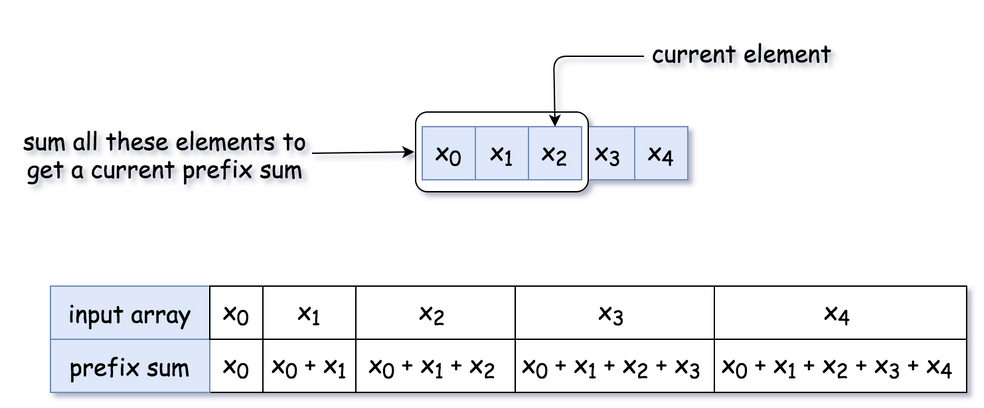
To get the total from x1 to x3 we need prefix[x3] - prefix[x0]
2D Prefix sums are harder because you need to keep track of adjacent cells, however this is useful in Arrays, Dynamic Programming, and some Graph problems
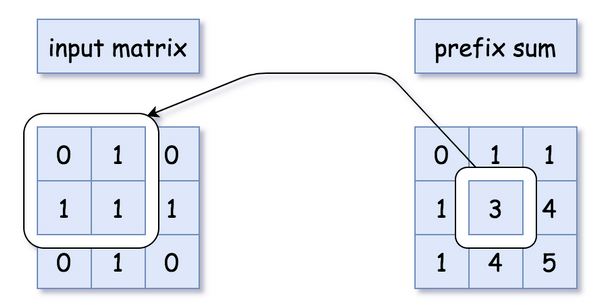
There are even tree path prefix sums!
Subarray Sum = K
Counting the number of subarrays with sum = k, determining the longest subarray with sum = k, etc all revolve around the same setup with different tracking of resp
Utilizing {0: 1} is critical to represent the empty prefix - before any processing is done, there is at least one single prefix sum that is 0 which is []. After that, is there's a prefix = k exactly equal to k somewhere out there, it means the length is equal to starting at the initial empty prefix list
Show Python Script
def subarraySum(nums, k):
    n_subarrays = 0

    # freq {0: 1} is critical, because if a specific
    #   prefix value is equal to k, then it's the length
    #   of the entire array
    freq = {0: 1}

    prefix = 0
    for idx, num in enumerate(nums):
        prefix += num
        n_subarrays += freq.get(prefix - k, 0)
        freq[prefix] = freq.get(prefix, 0) + 1

    return(n_subarrays)
"""
[1, 3, 0,  6, -2,  2]
[1, 4, 4, 10,  8, 12]
k = 4
freq = {
  0: 1,
  1: 1,
  4: 2,
  8: 1,
  10: 1
  12: 1
}

resp is 3
"""
Longest Subarray Sum = k
To get the longest one, you'd just have to store the first index of a prefix found instead of total count of them. To find the shortest you need to store the last found prefix instead
The new way to start first = {0: -1} is the same idea as {0: 1} - the empty prefix. However in this scenario, if we have a prefix sum list like below:
arr = [1, 3, -2, 0, 4, 3, -2, -3]
pfx = [1, 4,  2, 2, 6, 9,  7   4]
If we are looking for the longest subarray with k=4, the length of it is going to be the entire subarray of length 8. If we use for idx, num in enumerate(nums), the actual index at the end of the array will be 7, and so utilizing first = {0: -1} accounts for the fact that the length is +1 the index of a 0-indexed array. The entire TLDR is that the length of the subarray if it's an exact prefix = k match is the current 0-indexed index plus 1
For anything not equal to the entire subarray, like from index 2 -> 4 or 3 -> 4, the length is going to be equal to idx - first[prefix - k]. In this example it would be 4 - 2 = 2 which is the size of the subarray [0, 4]
The length is similar - we still need to utilize r + 1 and l, so we can achieve length = r + 1 - l, which is much cleaner to think about versus other indexing options.
Show Python Script
def longestSubarray(nums, k):
    longest = 0
    first = {0: -1}

    prefix = 0
    for idx, num in enumerate(nums):
        prefix += num
        need = prefix - k
        if need in first:
            longest = max(
                longest,
                idx - first[need]
            )

        if prefix not in first:
            first[prefix] = idx

    return(longest)
Modulo / Remainder Variants
These are around counting subarrays whose sum is divisible by k, or whose sum has a remainder r, or something else similar. The main identity here is that:
If (prefix[r + 1] - prefix[l]) % k == 0, prefix[r + 1] % k == prefix[l] % k, and so if we simply store the remainders throughout the freq hash map, it's fine for us to come up with the same result. We're not looking for freq[prefix - k], we're looking for freq[remainder]
Show Python Script
def subarraysDivByK(nums, k):
    count = 0
    prefix = 0
    freq = {0: 1}

    for x in nums:
        prefix += x
        rem = prefix % k
        count += freq.get(rem, 0)
        freq[rem] = freq.get(rem, 0) + 1

    return count
Weird Variants
There are some other weird patterns / variants that are just prefix sum in disguise:
- Count Subarrays With Equal Number Of 0 And 1
- You can just transform all 0 to -1, and keep 1 as 1, and then the problem becomes "count subarrays with sum 0"
- Count Subarrays With Exactly K Odd Numbers
- Same thing as above - transform even to -1, and odd to 1, and then count subarrays with sum of 0
- Line Sweep is a greedy form of arrays that utilizes prefix sums to count how many overlapping intervals there are in things like meeting rooms and scheduling
Greedy Arrays
Greedy algorithms as a whole are any algorithms that makes the locally optimal decision at every step, and the locally optimal decisions ensure we reach the global optimal solution by the end. Local in this sense just refers to utilizing only the information at hand, it's not like Dynamic Programming where you are bringing some state along through adjacent variables, but a lot of greedy problems are mistaken for dynamic programming and vice versa
Array's aren't the only thing that can be greedy - most heap alogrithms over graphs can be considered greedy because you're taking the next best edge or node in some scenario. So locality is hard to pin down in terms of "next to current" / adjacent, it really just means "with current information"
The hardest part of these algorithms is proving they are the optimal solution. In a lot of scenario's a greedy algorithm gets us 90% of the way there (90% test cases passed), but it's not the truly optimal end-all-be-all solution. That being said, in greedy algorithms utilizing arr.sort() at the beginning and sorting by some thing is usually the best path forward!
A scary problem that looks like some combination of dynamic programming and hell is Partition An Array Such That the Maximum Difference Of Subsequences is K
Given nums = [3,6,1,2,5], k=2 we would want to split it into [3, 1, 2], [6, 5] and output 2. At first seeing subsequences, partitioning, etc brings about a ton of different choices, and so going through and finding the optimal solution is pretty difficult to prove. If there was a 0 involved in the array, our strategy here kinda breaks and we end up with [0, 1, 2], [3, 5], [6]. As we create more test cases the greedy solution starts to look useful, and then we can try and write out an invariant:
- Invariant: Adding all numbers to a group started by
startensures it's as large as possible, and for any otherstart*wherestart* < start - k(i.e. within the old group), adding it to thestartgroup can only help because it increases the bottom floor of the groupstart*was previously apart of - this will either maintain the same number of groups, or allow further groups to be consolidated and reduce the total number. Furthermore, our smallest item needs to be included in some group, and so our smallest item must be the initial start
In frontier expansion / interval merging problems, there's a general immediate thought for at every interval you have to go back and check if it overlaps with others. In Jump Game, at each index you want to see if you can reach that index from some other index, and in interval merging you want to check if the leftCoverage overlaps with otherRightCoverage or something similar. This is how humans look at these problems, but they can usually be solved in a "faster" way via greedy algorithms that aren't necessarily intuitive to humans - these algorithms come to the same solution, but over millions of arrays humans just wouldn't find this setup
- Jump Game Invariant: After processing index
i, everyindex <= furthestReachedSoFaris reachable. Therefore, if we just trackfurthestReachedSoFarbased on each index, we will be able to track if we're able to reach the end in some fashion - Jump Game 2 is similar, but since we need to track the minimum number of steps it takes, the invariant changes a little bit. At each step / layer we can commit to a certain length of a jump, and inside of that layer there's a set of certain lengths we can eventually reach. As long as we track
furthestInThisLayerandendOfThisLayer, we just need to track untilfurthestInThisLayer >= end. Once we reachcurrIdx = endOfThisLayerwe know we've checked all possible future coverages from this spot- Invariant: Before committing the next jump, scan all positions reachable in the current number of jumps
- This is the same idea as breadth first search, except compressed into greedy array scanning
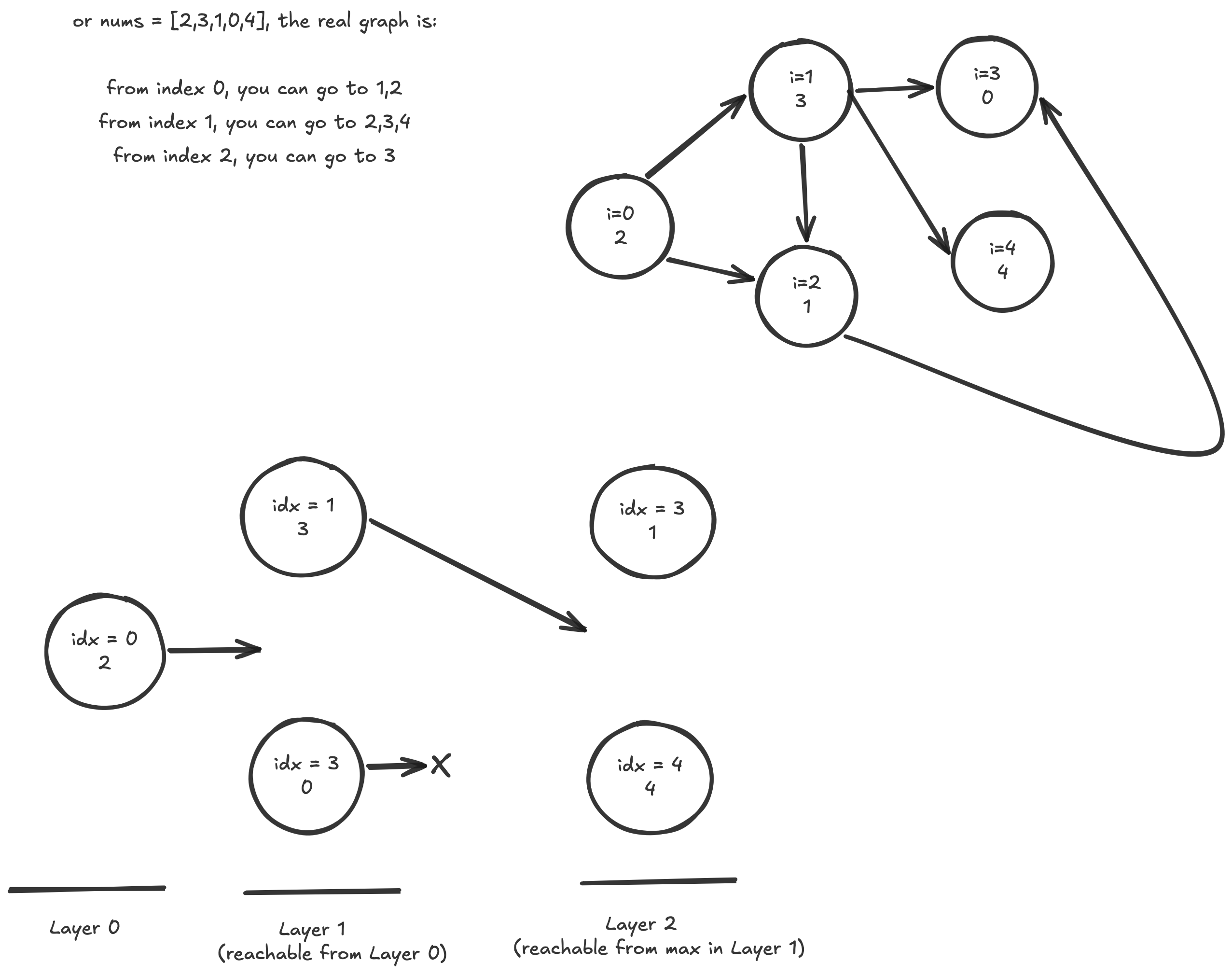
- What's convoluted here is that in BFS if you were to run shortest path you will run it in via an adjacency list, and this could turn out to be if each of the vertexes can reach all other neighbors
- In Jump Game we can bypass that and realize that all nodes in a current BFS layer are just indexes in an interval, and we can greedily pluck the furthest reaching one in each layer
Typically problem says something like:
- minimum number of jumps
- minimum intervals / machines / clips / taps
- cover a road / garden / timeline / segment
- each object covers a range
- from here you can go up to X
Line Sweep
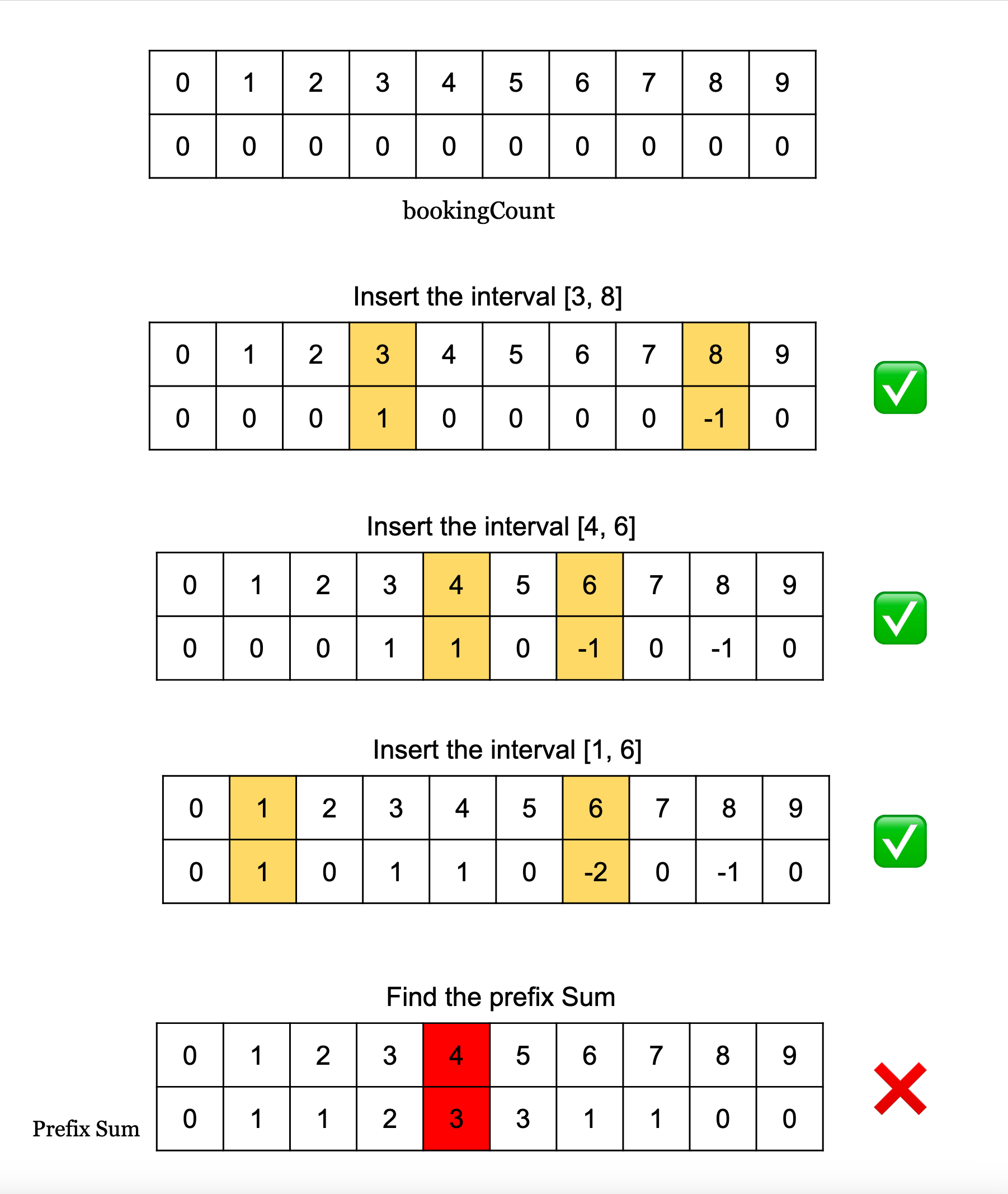
Line sweep is a variation of prefix sum that helps with overlapping interval problems. The general thought is that if we do +1 for the start, and -1 for the end along times, then the prefix sum array shows us the total number of overlaps at that point so far. It requires a SortedDict() in python so that we loop over the sorted keys, and so insertion is instead of , but everything else is the same
Show Python Script
self.helper = SortedDict()
self.maxOverlaps = 5 # just what to check for later

# does not need to be sorted
for intervalStart, intervalEnd in interval:
    self.helper[intervalStart] = self.helper.get(intervalStart, 0) + 1
    self.helper[intervalEnd] = self.helper.get(intervalEnd, 0) - 1

    currCumulSum = 0
    for intervalTime, intervalTimeCount in self.helper.items():
        currCumulSum += intervalTimeCount
        if currCumulSum > self.maxOverlaps:
            self.helper[intervalStart] = self.helper.get(intervalStart, 0) - 1
            self.helper[intervalEnd] = self.helper.get(intervalEnd, 0) + 1

            if self.helper[intervalStart] = self.helper.get(intervalStart, 0) == 0:
                del self.helper[intervalStart]
            if self.helper[intervalEnd] = self.helper.get(intervalEnd, 0) == 0:
                del self.helper[intervalEnd]

            return(False)

    return(True)
Kadane
Kadane's algorithm is used to find the maximum sum of a contiguous subarray
If it's all positive then we'd just take the entire array, if there are negatives we'd maybe include them. Any subarray whose sum is positive is worth keeping, and in particular any subarray whose sum is larger than just taking the current value is worth keeping
If we're at [-1, 20, -18, 1], the first 3 numbers are worth keeping because they contribute +1, but [-1, 20, -18, 1, -2] is useless - it's sum is 0. This logic can be completely encapsulated in currentMax = max(num, currentMax + num)
The only time currentMax + num < num is if currentMax < 0
Show Python Script
nums = [1, 3, 4, -8, 1, -2, 2, 5]
maxSoFar = nums[0]
currentMax = nums[0]
for num in nums[1:]:
    currentMax = max(num, currentMax + num)
    maxSoFar = max(maxSoFar, currentMax)

return(max_so_far)